

 Italiano
 Français
 Deutsch
 Español
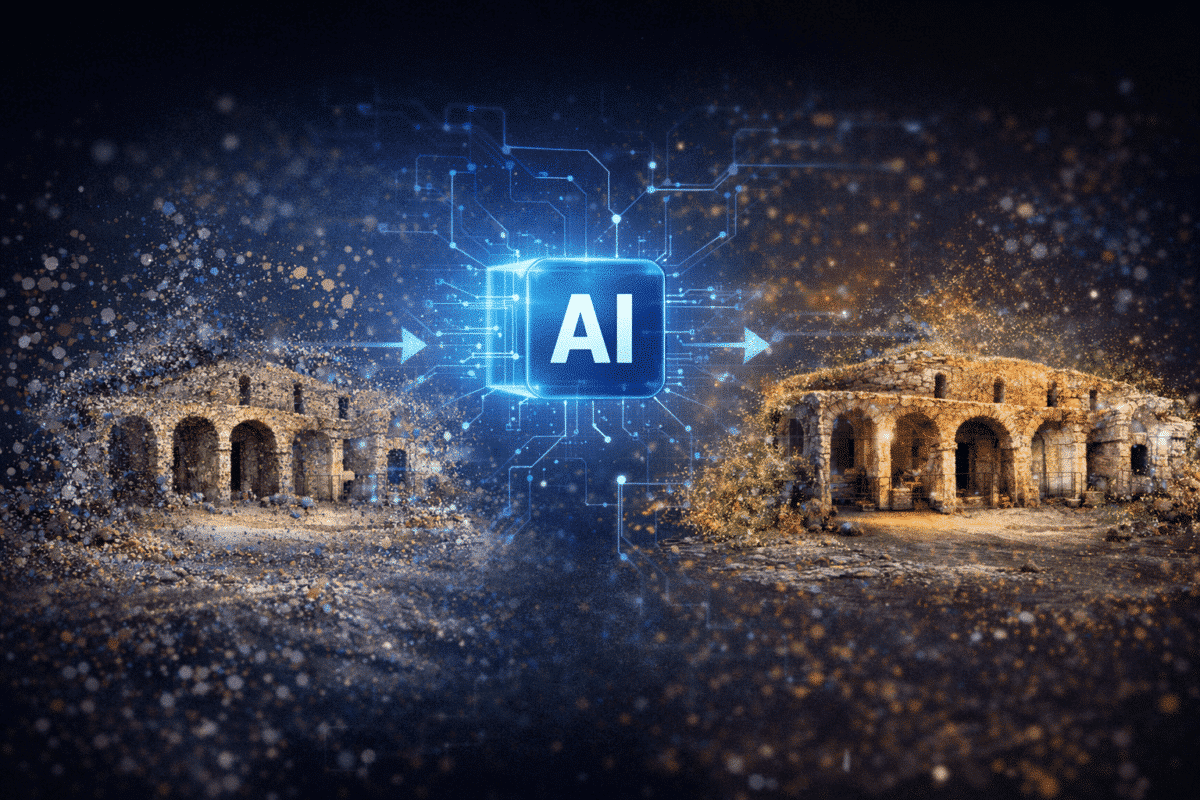
Photogrammetry has become one of the most powerful technologies for generating 3D models from images. Software such as Agisoft Metashape allows users to reconstruct detailed point clouds, meshes, and textured models from photographs captured by drones, cameras, or smartphones.
However, one common challenge in photogrammetry workflows is the presence of noise and unwanted artifacts within the generated point clouds. These imperfections can reduce model accuracy, increase processing time, and complicate downstream tasks such as mesh generation or volume calculations.
In recent years, artificial intelligence (AI) has emerged as a promising solution for improving the quality of photogrammetry data. AI-based algorithms can automatically detect outliers, classify points, and remove noise from point clouds much more efficiently than manual editing.
This article explores how AI techniques can be used to clean photogrammetry point clouds produced in Agisoft Metashape and how these methods can significantly improve 3D reconstruction workflows.
Why Point Cloud Cleaning is Important
When Metashape processes a set of photographs, it generates a sparse point cloud during image alignment and later produces a dense point cloud during depth reconstruction.
The dense cloud can contain millions of points representing the surfaces captured in the photographs. However, the reconstruction process may also introduce unwanted points caused by several factors:
- Image noise
- Poor lighting conditions
- Reflective surfaces
- Moving objects
- Vegetation movement
- Low image overlap
These unwanted points can create artifacts that affect the quality of the final mesh and textured model. Cleaning the point cloud is therefore an essential step in professional photogrammetry workflows.
Traditional Methods for Cleaning Point Clouds
Before the introduction of AI-based techniques, point cloud cleaning was mainly performed manually using editing tools available in photogrammetry software.
In Agisoft Metashape, users typically remove unwanted points using:
- Gradual selection tools
- Manual point selection
- Confidence filtering
- Reconstruction uncertainty filters
While these methods are effective, they can be time-consuming when working with very large datasets containing tens or hundreds of millions of points.
Manual cleaning also depends heavily on user experience and may introduce inconsistencies when processing multiple datasets.
How AI Improves Point Cloud Cleaning
Artificial intelligence offers a more automated approach to point cloud cleaning. Machine learning algorithms can analyze the structure of a point cloud and identify patterns that correspond to noise, outliers, or irrelevant objects.
AI models trained on large datasets can classify points based on features such as:
- Local point density
- Surface curvature
- Color consistency
- Spatial relationships between points
By learning from these characteristics, AI algorithms can distinguish between valid surface points and unwanted artifacts.
This automated classification process can dramatically reduce the time required to clean large photogrammetry datasets.
AI-Based Point Cloud Classification
One of the most useful applications of AI in point cloud processing is automatic classification.
Classification algorithms assign semantic labels to different groups of points within a cloud. For example, points can be categorized as:
- Ground
- Buildings
- Vegetation
- Noise
- Outliers
Once classification is complete, unwanted categories such as noise or isolated outliers can be removed automatically.
This process significantly simplifies the cleaning stage and allows users to focus on higher-level analysis rather than manual editing.
Integrating AI Tools with Metashape
Although Agisoft Metashape includes powerful built-in filtering tools, AI-based point cloud processing is often performed using external software.
A typical workflow may involve exporting the dense point cloud generated by Metashape and processing it with specialized AI tools.
The workflow typically follows these steps:
- Generate the dense point cloud in Metashape
- Export the point cloud in LAS, LAZ, or PLY format
- Process the dataset using AI-based classification tools
- Remove noise and unwanted points
- Import the cleaned point cloud back into Metashape
This hybrid workflow allows users to combine the reconstruction power of Metashape with advanced AI-based filtering techniques.
AI Software for Point Cloud Cleaning
Several software platforms now provide AI-based point cloud processing capabilities.
Some commonly used tools include:
- CloudCompare with machine learning plugins
- PDAL pipelines with classification filters
- Open3D machine learning tools
- AI-based LiDAR classification software
These tools use advanced algorithms to detect and remove noise while preserving the structure of the original dataset.
Benefits of AI-Assisted Point Cloud Cleaning
Using AI to clean photogrammetry point clouds offers several advantages compared to traditional manual methods.
Key benefits include:
- Faster processing of large datasets
- More consistent filtering results
- Reduced manual editing time
- Improved geometric accuracy
- Better mesh reconstruction
These improvements can be especially valuable when processing drone mapping projects or large-scale photogrammetry surveys.
Improving Mesh Generation with Clean Data
One of the most important benefits of point cloud cleaning is the improvement of mesh generation.
When a dense point cloud contains many outliers, the mesh generation process may create unwanted surfaces or holes in the model.
By removing noise and outliers beforehand, the mesh reconstruction step can produce a cleaner and more accurate 3D surface.
This leads to higher-quality models suitable for visualization, simulation, or measurement tasks.
Challenges and Limitations
Despite its advantages, AI-based point cloud cleaning is not without challenges.
Machine learning models require training data and may not always perform perfectly when applied to unfamiliar environments.
Potential limitations include:
- Incorrect classification of complex structures
- Loss of fine details if filtering is too aggressive
- Dependence on external software tools
For this reason, AI-assisted cleaning is usually combined with manual inspection to ensure optimal results.
The Future of AI in Photogrammetry
Artificial intelligence is rapidly transforming many aspects of photogrammetry workflows. In the future, AI-based tools may become fully integrated into photogrammetry software, enabling automated noise removal and dataset optimization.
Future developments may include:
- Real-time point cloud filtering
- Automated scene classification
- AI-assisted mesh reconstruction
- Improved error detection during processing
These innovations could dramatically reduce processing time and make photogrammetry workflows more efficient.
Conclusion
Cleaning point clouds is an essential step in any photogrammetry workflow, especially when working with large datasets generated by drones or high-resolution cameras.
By integrating artificial intelligence techniques into the processing pipeline, professionals can significantly improve the quality of point clouds generated in Agisoft Metashape.
AI-assisted filtering allows users to remove noise more efficiently, improve mesh reconstruction, and produce higher-quality 3D models with less manual effort.
As AI technologies continue to evolve, they are likely to become an increasingly important component of modern photogrammetry workflows.