

 Italiano
 Français
 Deutsch
 Español
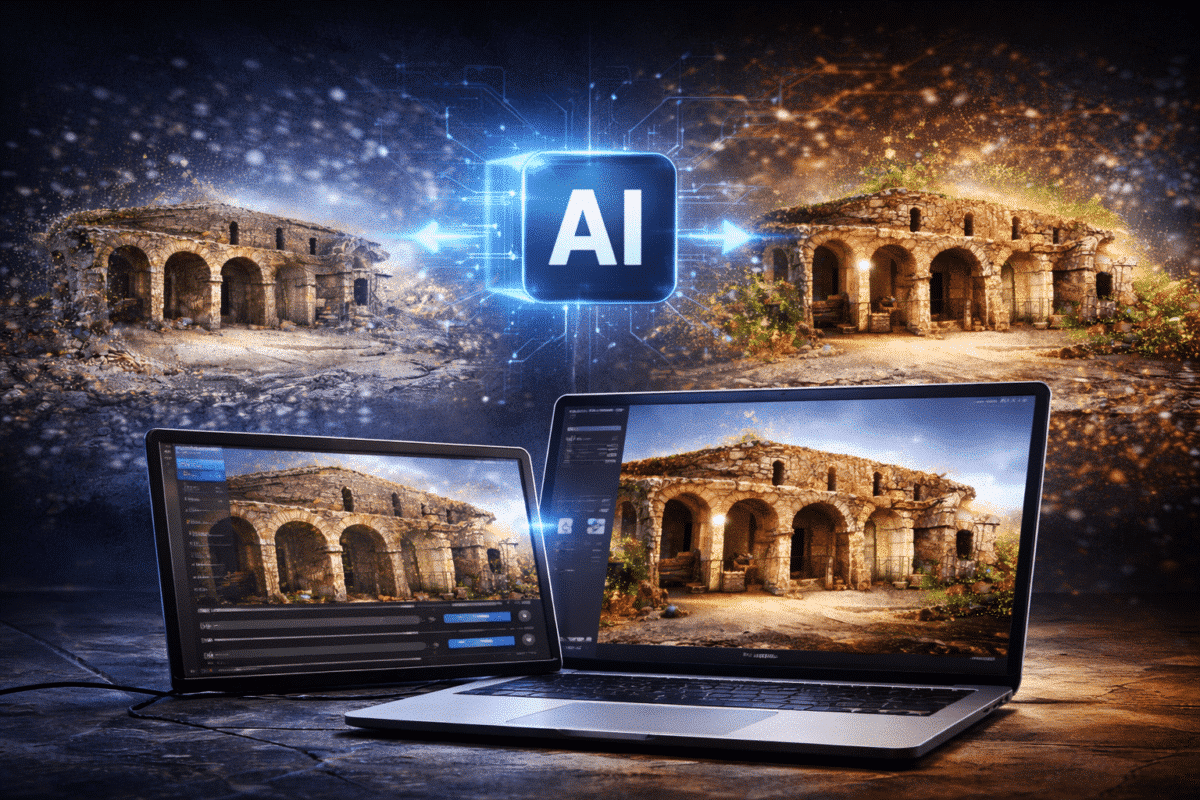
Photogrammetry has become one of the most widely used techniques for generating realistic 3D models from photographs. Software such as Agisoft Metashape allows users to reconstruct detailed geometry and textures from images captured by drones, cameras, or smartphones.
While photogrammetry can produce highly accurate models, the visual quality of the final result often depends heavily on the resolution and quality of the input images. In many cases, texture maps generated during reconstruction may appear slightly blurred or lack the level of detail required for high-end visualization.
This is where AI upscaling technologies can play a crucial role. Artificial intelligence-based image enhancement tools can increase the resolution and sharpness of textures, improving the overall realism of photogrammetry models.
In this article, we explore how AI upscaling works and how it can be integrated into Agisoft Metashape workflows to enhance photogrammetry textures.
Understanding Photogrammetry Textures
During the photogrammetry process, software such as Metashape reconstructs a three-dimensional model using multiple overlapping photographs. Once the geometry of the scene is generated, the software creates a texture map by projecting the original images onto the mesh surface.
This texture map defines the color and visual appearance of the model.
The quality of the final texture depends on several factors:
- Resolution of the original photographs
- Image sharpness and focus
- Lighting conditions during capture
- Camera sensor quality
- Texture resolution settings in Metashape
Even with high-resolution input images, textures may sometimes appear softer than expected due to image blending or compression during the reconstruction process.
What is AI Image Upscaling?
AI image upscaling refers to the use of machine learning algorithms to increase the resolution of images while preserving or enhancing visual detail.
Unlike traditional interpolation methods, which simply stretch pixels to create larger images, AI upscaling algorithms analyze patterns within the image and predict new high-resolution details.
Modern AI upscaling models are trained using millions of images. By learning how textures and patterns typically appear at higher resolutions, these models can generate sharper and more detailed images.
Popular AI upscaling technologies include deep learning models based on convolutional neural networks (CNNs) and generative adversarial networks (GANs).
Why Texture Quality Matters in Photogrammetry
While geometric accuracy is important in many photogrammetry applications, texture quality plays a crucial role in visual realism.
High-quality textures are particularly important in fields such as:
- Digital heritage documentation
- Virtual museums
- Gaming and virtual environments
- Film and visual effects
- Architectural visualization
Detailed textures allow viewers to perceive subtle surface features such as cracks, materials, and weathering patterns.
Improving texture resolution can therefore dramatically enhance the perceived quality of a 3D model.
Applying AI Upscaling to Photogrammetry Workflows
AI upscaling can be integrated into photogrammetry workflows in several different ways.
The most common approach involves applying AI enhancement after the texture map has been generated in Metashape.
A typical workflow may include the following steps:
- Process images and generate the 3D model in Agisoft Metashape
- Export the texture map from the project
- Process the texture using AI upscaling software
- Replace the original texture with the enhanced version
This process allows users to improve texture quality without altering the underlying geometry of the model.
Enhancing Original Images Before Processing
Another approach involves applying AI enhancement to the original photographs before running the photogrammetry process.
In this case, the workflow begins by improving the resolution and clarity of the input images.
The benefits of this method include:
- Improved feature detection during image alignment
- Higher resolution texture maps
- Potentially sharper mesh reconstruction
However, it is important to ensure that AI enhancement does not introduce artificial details that could interfere with the reconstruction process.
Benefits of AI Upscaling for Metashape Users
Integrating AI upscaling into photogrammetry workflows offers several advantages.
The most significant benefits include:
- Sharper and more detailed textures
- Improved visual realism
- Better presentation quality for 3D models
- Enhanced results from lower-resolution images
- Reduced need for extremely high-resolution cameras
These improvements can be particularly useful for projects where visual quality is more important than strict geometric accuracy.
Challenges and Limitations
Despite its advantages, AI upscaling also has limitations that users should consider.
Because AI models generate new pixel information based on learned patterns, the resulting details are not always perfectly accurate representations of the real surface.
Potential challenges include:
- Artificial details generated by the AI model
- Inconsistent enhancement across textures
- Long processing times for very large textures
- Increased file sizes for high-resolution maps
For applications that require strict accuracy, AI-enhanced textures should therefore be used primarily for visualization rather than measurement.
Future of AI in Photogrammetry Texturing
Artificial intelligence is increasingly influencing many aspects of photogrammetry workflows.
In the future, AI technologies may become fully integrated into photogrammetry software, allowing automatic texture enhancement directly during reconstruction.
Possible developments include:
- Real-time texture upscaling
- AI-based texture denoising
- Automated color correction
- Advanced texture super-resolution
These innovations could significantly improve the visual quality of photogrammetry models without requiring manual editing.
Conclusion
AI upscaling represents a powerful tool for improving the visual quality of photogrammetry textures generated in Agisoft Metashape.
By enhancing image resolution and sharpening fine details, AI technologies can transform standard photogrammetry outputs into highly realistic 3D models suitable for visualization, simulation, and immersive experiences.
While AI enhancement should be applied carefully in workflows that require strict geometric accuracy, it offers tremendous potential for creative and visual applications.
As artificial intelligence continues to evolve, it will likely become an increasingly important component of photogrammetry pipelines, enabling users to achieve higher levels of realism and detail in their 3D reconstructions.