

 Italiano
 Français
 Deutsch
 Español
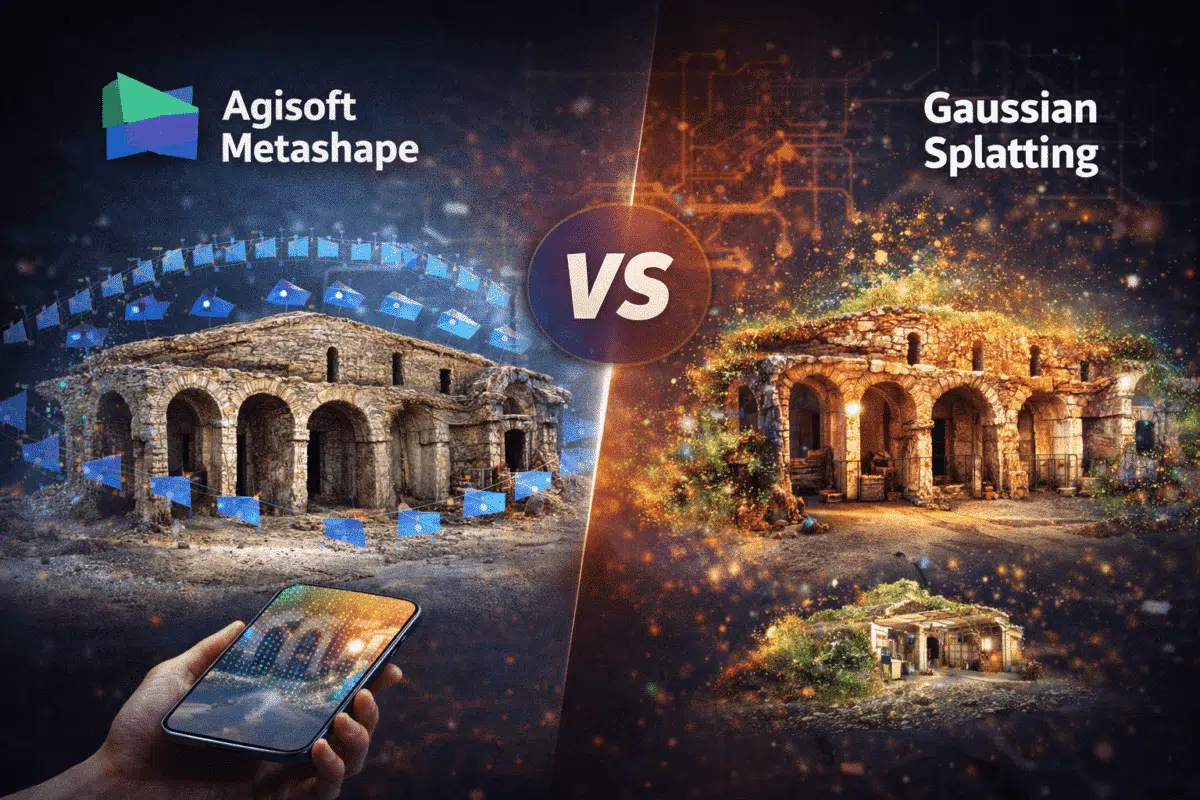
3D reconstruction technologies are evolving rapidly. For more than a decade, photogrammetry software such as Agisoft Metashape has been widely used to generate accurate 3D models from photographs captured by drones, cameras, and mobile devices.
However, a new technology has recently emerged in the computer vision community: Gaussian Splatting. This innovative technique promises real-time rendering of complex scenes using machine learning and advanced point-based representations.
As researchers and developers explore this new approach, many professionals are asking an important question: Could Gaussian Splatting eventually replace traditional photogrammetry workflows?
In this article, we compare Agisoft Metashape and Gaussian Splatting, examining how each technology works, their strengths and limitations, and what the future may hold for 3D reconstruction.
What is Agisoft Metashape?
Agisoft Metashape is one of the most widely used photogrammetry software solutions available today. It allows users to generate highly detailed 3D models from overlapping photographs using advanced computer vision algorithms.
The workflow used by Metashape follows a well-established photogrammetry pipeline:
- Image alignment using feature matching
- Sparse point cloud generation
- Dense point cloud reconstruction
- Mesh generation
- Texture mapping
This process converts two-dimensional photographs into accurate three-dimensional geometry.
Metashape is used across many industries including:
- Drone mapping and surveying
- Cultural heritage preservation
- Construction monitoring
- Mining and volume calculations
- Environmental research
Because the software focuses on geometric accuracy, it is widely trusted for professional applications that require measurable results.
What is Gaussian Splatting?
Gaussian Splatting is a relatively new technique for rendering and representing 3D scenes. It was introduced by researchers as an alternative to traditional mesh-based or voxel-based reconstruction methods.
Instead of reconstructing a solid surface model, Gaussian Splatting represents a scene using thousands or millions of small 3D Gaussian primitives. Each Gaussian element contains information about position, color, opacity, and orientation.
These primitives are projected onto the screen in real time, creating highly realistic visualizations of complex scenes.
The technology is closely related to other neural rendering approaches such as Neural Radiance Fields (NeRF), but Gaussian Splatting is significantly faster and more suitable for interactive applications.
Key characteristics of Gaussian Splatting include:
- Real-time rendering performance
- Photorealistic scene representation
- No traditional mesh generation
- Efficient handling of complex geometry
Because of these advantages, Gaussian Splatting has gained significant attention in the fields of computer graphics, virtual reality, and digital content creation.
Key Differences Between Metashape and Gaussian Splatting
Although both technologies can generate 3D representations from images, their underlying approaches are fundamentally different.
Agisoft Metashape focuses on reconstructing precise geometry that can be measured and analyzed. Gaussian Splatting, on the other hand, focuses on visual realism and rendering efficiency.
The most important differences include:
- Geometry: Metashape generates meshes and point clouds, while Gaussian Splatting represents scenes with Gaussian primitives.
- Accuracy: Metashape is designed for metric accuracy and surveying workflows.
- Rendering: Gaussian Splatting is optimized for real-time visualization.
- Applications: Metashape is widely used in engineering and mapping, while Gaussian Splatting is currently more common in graphics research.
These differences mean that the two technologies serve different purposes.
Advantages of Agisoft Metashape
Despite the emergence of new rendering technologies, photogrammetry software like Metashape continues to offer several key advantages.
The most important strength of Metashape is its ability to produce accurate and measurable 3D data.
Key benefits include:
- High geometric accuracy
- Reliable survey-grade outputs
- Orthomosaics and DEM generation
- Full control over reconstruction parameters
- Integration with GIS workflows
These capabilities make Metashape an essential tool in industries where precision is critical.
Advantages of Gaussian Splatting
Gaussian Splatting offers several advantages in terms of visualization and rendering performance.
Because it does not rely on complex mesh geometry, scenes can be rendered extremely quickly even when they contain millions of points.
Important benefits include:
- Real-time rendering of complex scenes
- High visual realism
- Efficient representation of fine details
- Reduced memory usage compared to traditional meshes
These features make Gaussian Splatting particularly interesting for applications such as virtual environments, immersive experiences, and digital media production.
Limitations of Gaussian Splatting
Although Gaussian Splatting is a promising technology, it still has several limitations compared to traditional photogrammetry.
The most important limitation is the lack of precise geometric structure. Because the scene is represented as a collection of Gaussian elements rather than a solid surface model, it is difficult to perform accurate measurements.
Other limitations include:
- No traditional mesh output
- Limited support for engineering workflows
- Still primarily a research technology
- Limited integration with GIS and CAD systems
For these reasons, Gaussian Splatting currently complements photogrammetry rather than replacing it.
Will Gaussian Splatting Replace Photogrammetry?
At the moment, it is unlikely that Gaussian Splatting will replace photogrammetry software such as Agisoft Metashape.
Photogrammetry has been refined over decades and is deeply integrated into professional workflows across many industries. Its ability to generate accurate geometric models remains essential for surveying, engineering, and scientific analysis.
However, Gaussian Splatting may play an increasingly important role in visualization and real-time rendering.
In the future, hybrid workflows could combine both approaches:
- Photogrammetry for accurate geometry
- Gaussian Splatting for interactive visualization
This combination could enable faster and more immersive ways to explore complex 3D datasets.
The Future of 3D Reconstruction
The field of 3D reconstruction is evolving quickly as new technologies emerge from both the photogrammetry and machine learning communities.
Tools like Agisoft Metashape will likely remain essential for high-accuracy modeling and mapping workflows, particularly in industries that require precise measurements.
At the same time, techniques such as Gaussian Splatting are pushing the boundaries of real-time visualization and immersive rendering.
Rather than competing directly, these technologies may ultimately complement each other and expand the possibilities of 3D scene capture and representation.
Conclusion
Agisoft Metashape and Gaussian Splatting represent two different approaches to the challenge of reconstructing 3D environments from images.
Metashape remains one of the most reliable tools for producing accurate photogrammetry models used in mapping, engineering, and scientific applications.
Gaussian Splatting, on the other hand, introduces an exciting new way to render complex scenes with remarkable visual realism and performance.
As 3D reconstruction technologies continue to evolve, professionals will likely see a growing ecosystem of tools that combine accurate photogrammetry with advanced real-time visualization techniques.
Understanding the strengths of both approaches will help researchers, engineers, and creators choose the best solution for their specific projects.